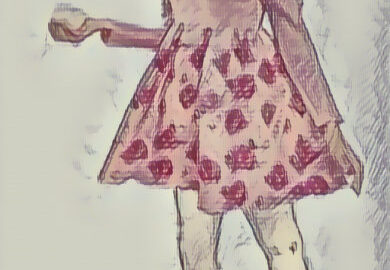
It’s a bit dark, more distopia than dysphoria and I guess the moral’s be careful what you wish for
Tessa vaguely remembered Richard the small boy whose father dragged him to the park to kick a football. He had been left behind when Tessa was taken away to school where she learned how to cook, look after baby and make pretty things to wear. Nobody ever made Tessa kick a football.
The OED gives several possible derivations for the word ‘mem’; the most commonly believed is that it is a contraction of ‘men mums’ though it is also suggest that it is a Hindi word reintroduced by Asian immigrants as Britain’s third gender became established.
Like most changes it didn’t happen overnight and there was no one cause. If you had to point to the major contributory fact it was probably house prices; by 2010 it was impossible to get a mortgage with one income and high repayments made it incredibly difficult to take time away from a career to carry, let alone bring up children. For a time the au pair seemed to offer the best solution, but tighter immigration controls and minimum wages soon ended that.
Over the course of the following decade the structure of the middle-class family changed quite radically with a third partner added. Not an equal partner in most cases, it was usually someone quite passive, not particularly well educated who would stay home to look after the children and keep house. Surprisingly, or perhaps not, given decades of feminism most of these new housewives were men and a significant proportion crossdressed.
Towards the end of the decade an American doctor named a surgical procedure known as the ‘Pargeter Pocket’ which enabled a male to carry a child to term. To Americans the procedure was something of a novelty hardly used but in Britain it was seized with both hands, in many cases companies would pay for the surgery to keep a female employee in work and avoid maternity pay.
Suddenly the mem became a valuable commodity and there were several high profile cases where parents had forced a child into the role hoping to extract a dowry from a wealthy couple. Faced with allegations of systematic child abuse (and a potential revenue source) the government stepped in. A programme of screening for suitable children was put in place; boys of small stature, passive personality and slightly below average intelligence were considered the ideal (girls of a similar profile were channelled into the care professions for the ageing population).
So despite his father’s efforts Richard had been taken into government care and brought up as Tessa. Her first years’ education emphasised a traditionally female role, she was taught to read and count but mainly to cook and clean. It was not until the onset of puberty that physical changes were made to a mem, there were hormone therapy and some surgery. Mems were given softer facial features, wider eyes and lips, and where necessary breast augmentation.
Tessa had surprised everyone with a premature growth spurt shortly before her twelfth birthday which had carried her up to almost five feet ten far taller than a mem was usually allowed to reach. Her doctors had considered surgery to reduce her height: it was an expensive procedure however instead they gave her a little more cosmetic surgery to reinforce her feminine appearance. Like all mems though the surgery stopped short of full gender reassignment (that was reserved for genuine cases of gender Dysphoria turned up by the programme).
Long vilified, the beauty pageant had made reappearance in Britain, an officially sanctioned shopwindow for the mem programme (‘miss’ was a title applied only to mems by then genetic women preferring ‘ms’). Tessa had competed in her first at sixteen progressing through regional heats to the national final shortly before her eighteenth birthday. She was a vision of ultra femininity by this time, tall, willowy and with a wide eyed innocence of Disney proportions. There was some public consternation when she did not win the judges marking her down for her above average height.
It’s a bit dark, more distopia than dysphoria and I guess the moral’s be careful what you wish for
Tessa vaguely remembered Richard the small boy whose father dragged him to the park to kick a football. He had been left behind when Tessa was taken away to school where she learned how to cook, look after baby and make pretty things to wear. Nobody ever made Tessa kick a football.
The OED gives several possible derivations for the word ‘mem’; the most commonly believed is that it is a contraction of ‘men mums’ though it is also suggest that it is a Hindi word reintroduced by Asian immigrants as Britain’s third gender became established.
Like most changes it didn’t happen overnight and there was no one cause. If you had to point to the major contributory fact it was probably house prices; by 2010 it was impossible to get a mortgage with one income and high repayments made it incredibly difficult to take time away from a career to carry, let alone bring up children. For a time the au pair seemed to offer the best solution, but tighter immigration controls and minimum wages soon ended that.
Over the course of the following decade the structure of the middle-class family changed quite radically with a third partner added. Not an equal partner in most cases, it was usually someone quite passive, not particularly well educated who would stay home to look after the children and keep house. Surprisingly, or perhaps not, given decades of feminism most of these new housewives were men and a significant proportion crossdressed.
Towards the end of the decade an American doctor named a surgical procedure known as the ‘Pargeter Pocket’ which enabled a male to carry a child to term. To Americans the procedure was something of a novelty hardly used but in Britain it was seized with both hands, in many cases companies would pay for the surgery to keep a female employee in work and avoid maternity pay.
Suddenly the mem became a valuable commodity and there were several high profile cases where parents had forced a child into the role hoping to extract a dowry from a wealthy couple. Faced with allegations of systematic child abuse (and a potential revenue source) the government stepped in. A programme of screening for suitable children was put in place; boys of small stature, passive personality and slightly below average intelligence were considered the ideal (girls of a similar profile were channelled into the care professions for the ageing population).
So despite his father’s efforts Richard had been taken into government care and brought up as Tessa. Her first years’ education emphasised a traditionally female role, she was taught to read and count but mainly to cook and clean. It was not until the onset of puberty that physical changes were made to a mem, there were hormone therapy and some surgery. Mems were given softer facial features, wider eyes and lips, and where necessary breast augmentation.
Tessa had surprised everyone with a premature growth spurt shortly before her twelfth birthday which had carried her up to almost five feet ten far taller than a mem was usually allowed to reach. Her doctors had considered surgery to reduce her height: it was an expensive procedure however instead they gave her a little more cosmetic surgery to reinforce her feminine appearance. Like all mems though the surgery stopped short of full gender reassignment (that was reserved for genuine cases of gender Dysphoria turned up by the programme).
Long vilified, the beauty pageant had made reappearance in Britain, an officially sanctioned shopwindow for the mem programme (‘miss’ was a title applied only to mems by then genetic women preferring ‘ms’). Tessa had competed in her first at sixteen progressing through regional heats to the national final shortly before her eighteenth birthday. She was a vision of ultra femininity by this time, tall, willowy and with a wide eyed innocence of Disney proportions. There was some public consternation when she did not win the judges marking her down for her above average height.
Like all the contestants when asked what were her ambitions she said to find a nice family and be a good memmy. Tessa had little problem achieving this, there was a whole government department that placed mems with families. Nice middle class families of course who could pay the registration fees, and whose income was in the appropriate tax bracket.
Giles and Jessica Marstone had met at college, worked together in the same accountancy practice and in their late twenties were financially secure enough to think about starting a family. The process took about three years, with interviews, psychometric tests and courses to attend to make sure they knew how to look after their mem. They were overjoyed to be introduced to Tessa and following a small civil ceremony welcomed her into their home.
Tessa was a delight as she had been brought up to be – undemanding, industrious and loving, she was all the Marstones could want and they proudly showed her off. There was only one problem, Tessa had slept in dormitories for most of her life and was painfully lonely alone in her room. All the training courses said this would pass but she cried every night for weeks until Giles and Jessica did what they had been told not to bringing the beautiful, gentle creature into their bed at night.
Physical intimacy with your mem was frowned upon, if not actually banned but Jess and Giles were an affectionate couple and Tessa had been brought up to be loveable. Despite their best efforts they slowly introduced her into their lovemaking.
Mems had to undertake a twelve month probationary period before beginning the process of carrying a child for the adoptive couple. Tessa’s twelve months sped by without a hitch she had the house to look after during the day and older mem friends in the street to visit and entertain who gave her valuable advice on preparing herself for her first baby.
If anything Jessica and Giles became more affectionate as their child began to swell in Tessa’s belly, they pampered her both day and night and basked in the attention they attracted on visits to antenatal classes. There were no labour pains to support a mem through but they elected for a local anaesthetic for the delivery so Tessa could be part of the experience (if well drugged).
The weeks immediately following the birth were even more intimate. Jessica had taken a series of hormone treatments so she could share the breastfeeding burden with Tessa, Giles played the doting Dad to perfection changing Ben’s nappies and taking his turn at quieting the baby at night. Problems only began when both returned to work; Jess became jealous of the time Tessa spent with her baby, while colleagues had been warning them both of the danger of Ben becoming a ‘memmy’s boy’ who would in turn be taken by the mem programme.
For their first time Tessa was banished from their bed at night so they could look after baby Ben. When she started getting up at night to take care of him Tessa found herself locked in her room. It was only the first of several changes the Marstone’s made. They took away most of Tessa’s clothes and gave her a uniform in their place. It was not an unusual step, if they had followed their training to the letter Tessa would have worn uniform from the outset, and been subject to mild corporal punishment. Most upsetting though was the withdrawal of affection when the three of them were physically intimate; when she was taking into their bed again it was not as an equal partner but as an object.
Tessa was still loyal to the family and never mentioned the changes to her health visitor (just as she had never told her about sharing the Marstone’s bed). Instead she confided in Karen, an older mem who lived next door and was always willing to offer a shoulder to cry on. After Tessa had recounted one particularly demeaning sex act Giles had made her perform, Karen left the room returning with a dog eared paperback which she pressed into Tessa’s hand telling her to keep it hidden.
‘The New Misogyny’ had been published by a civil liberties organisation calling mems a new slave class and calling for an end to the screening programme. After a brief furore it had dipped out of the public consciousness until it reappeared in a new edition. Tessa enjoyed reading but like most mems her reading age was around twelve years, a whole publishing industry had sprung up to provide stories of good motherhood in simple, almost childish English. In its original edition ‘The New Misogyny’ would have been incomprehensible to mems which is why another more radical group had it ‘translated’ it into simpler language.
In its pages Tessa learned that she did not have to do everything the Marstone’s demanded to be a good mother (not memmy) to Ben, that the Marstone’s were wrong to expect blind obedience to their every whim. The change in her behaviour took them by surprise and for a while they were more circumspect with Tessa. Frustration took its toll however and Tessa found herself subject to more punishments, her clothes were all taken away, she was forbidden to leave the house or have visitors and was banished to her increasingly bare room while the Marstone’s were home. She could have told her health visitor about this but feared that she would be taken from her baby if she did.
Eventually the decision was taken away from her when Giles found her copy of ‘The New Misogyny’ hidden under the mattress. The book was not officially banned, but the translated edition was deemed in breach of copyright (even though the original authors had waived it) and all copies were confiscated as contraband. It was just the excuse Giles needed to replace Tessa with a more subservient mem, one who would be taught her place from the start.
A few days later the health visitor arrived with two police officers to remove Tessa. Giles had to grip his son’s shoulders hard to prevent him running after his mummy, and Ben cried bitterly for them to stop. Tessa’s eyes were streaming too though she offered no resistance. She knew now that this was the potential fate of all mems, to live like slaves or be taken from their children. Her tears were not for herself, she cried for the little boy who loved to touch his memmy’s clothes, to wear her make up and who would inevitably share her fate.